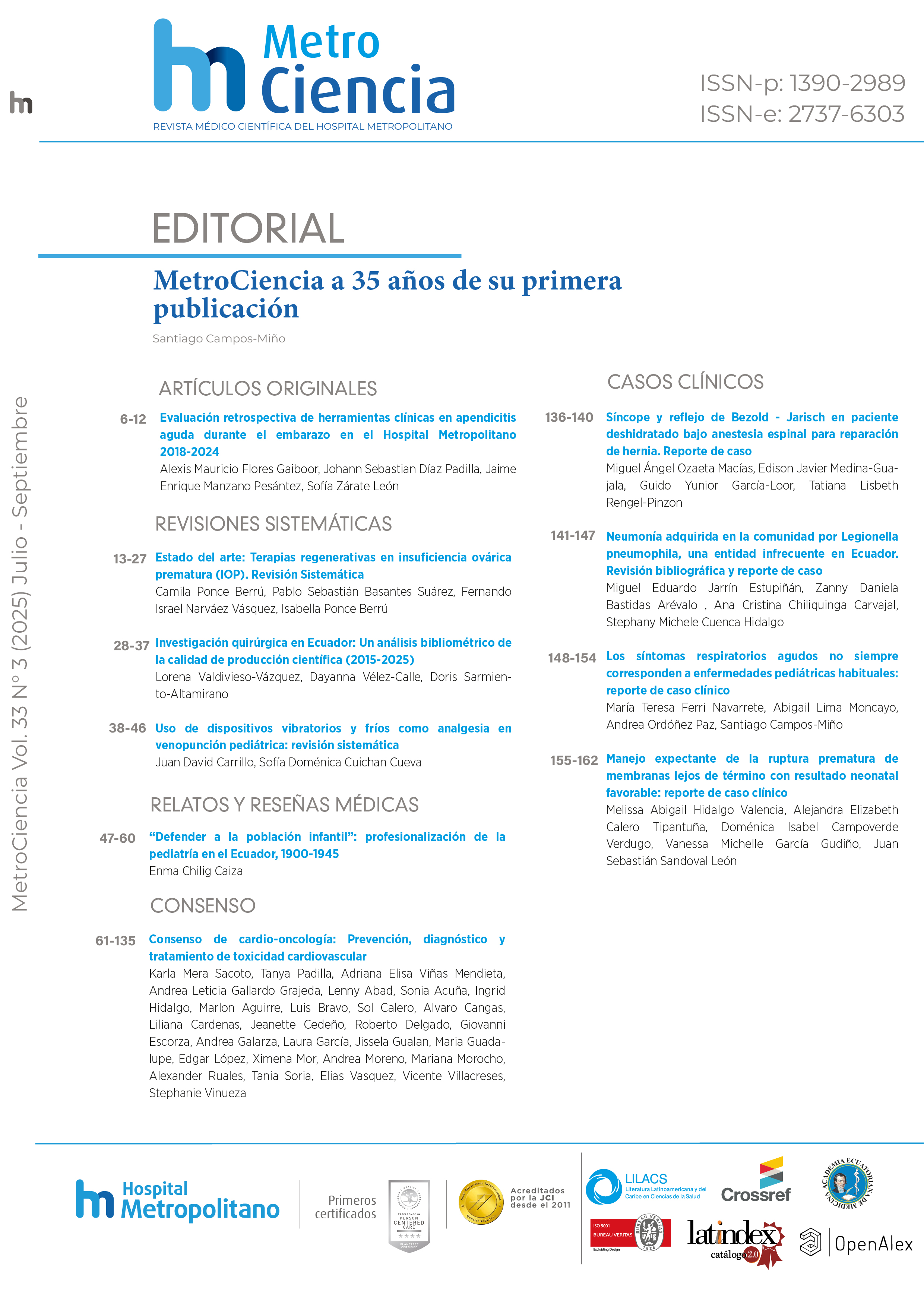
Use of vibratory and cold devices as analgesia in pediatric venipuncture: systematic review.
DOI:
https://doi.org/10.47464/MetroCiencia/vol33/3/2025/38-46Keywords:
analgesia, pain, cold, fear, pediatrics, cryotherapy, venipunctureAbstract
Introduction: Acute pain induced by invasive procedures such as venipuncture is a preventable cause of suffering in the pediatric population. Inadequate pain management can lead to anticipatory anxiety, adverse physiological responses, and rejection of future medical procedures. Devices that combine vibration and cold have been proposed as effective non-pharmacological analgesic interventions to reduce pain and anxiety during venipuncture in pediatric patients. Methods: A systematicreview with a descriptive approach was conducted, gathering information from PubMed, Scopus, and SciELO databases over the past seven years, using the following keywords: “analgesia,” “pain,” “cold,” “fear,” “teraphy”, “pediatrics,” “venipuncture,” “vibration.” Article selection was performed using the RAYYAN application, involving debate and selection, with inclusion and exclusion criteria applied by three independent researchers. The PRISMA flowchart was used to illustrate article selection and final inclusion. Risk of bias was assessed using the ROBINS-I criteria and analyzed with the “robvis” tool. Results: Six articles were obtained from the three indexed databases and gray literature. Conclusions: The evidence obtained supports the systematic use of vibration and cold devices as non-pharmacological analgesic strategies in pediatric venipuncture, promoting more humanized, effective, and safe clinical experiences. Their implementation could positively transform clinical practice, improving care quality and acceptance of future medical interventions in pediatric patients.
Downloads
References
Ali S, McGrath T, Drendel AL. An evidence-based approach to the management of acute procedural pain in children. Pediatr Emerg Care. 2021;37(3):160–6. Disponible en: https://journals.lww.com/pec-online/Fulltext/2021/03000/An_Evidence_Based_Approach_to_the_Management_of.2.aspx
Ballard A, Khadra C, Adler S, Doyon-Trottier E, Le May S. Efficacy of the Buzzy® device for pain management of children during needle-related procedures: a systematic review protocol. Syst Rev. 2018;7:78. Disponible en: https://www.ncbi.nlm.nih.gov/pmc/articles/PMC5964660/
Inal S, Kelleci M. The effect of external thermomechanical stimulation and distraction on reducing pain experienced by children during blood drawing. Int J Nurs Pract. 2018;24(6):e12696. Disponible en: https://pubmed.ncbi.nlm.nih.gov/28885392/
Biran V, Blanchard AC, Dos Santos F, et al. Non-pharmacological interventions for procedural pain in children: a meta-analysis. Pain. 2023;164(2):e78–87. Disponible en: https://journals.lww.com/pain/Fulltext/2023/02000/Non_pharmacological_interventions_for_procedural.12.aspx
Uman LS, Birnie KA, Noel M, Parker JA, Chambers CT, McGrath PJ. Psychological interventions for needle-related procedural pain and distress in children and adolescents. Cochrane Database Syst Rev. 2018;10:CD005179. Disponible en: https://pubmed.ncbi.nlm.nih.gov/30284240/
Su HC, Hsieh CW, Lai NM, Chou PY, Lin PH, Chen KH. Using vibrating and cold device for pain relief in children: a systematic review and meta-analysis of randomized controlled trials. J Pediatr Nurs. 2021;58:1–9. Disponible en: https://www.pediatricnursing.org/article/S0882-5963(21)00069-5/abstract
Gertz S, Francis S, Lawrence R. A comparison of distraction techniques for reducing pain and anxiety during pediatric procedures. J Pediatr Nurs. 2021;59:25–30. Disponible en: https://www.researchgate.net/publication/51650015_Distraction_Techniques_for_Children_Undergoing_Procedures_A_Critical_Review_of_Pediatric_Research
Ahmed SM, Tawfique AH, Sayed YM. Effect of Buzzy and watching cartoons on venipuncture pain among children undergoing phlebotomy. Egypt J Health Care. 2023;14(1):993–1006. doi:10.21608/ejhc.2023.292665. Disponible en: https://ejhc.journals.ekb.eg/article_292665_bc66937e9a4ed7067dd73da538e005e0.pdf
Al Battashi G, Al-Shibli ZS, Alghafri AI, Alyazeedi OM, Alkalbani AS, Francis F, et al. Effectiveness of the Buzzy Bee device on pain perception during invasive pricks among school-age children: an interventional study. J Educ Health Promot. 2024;13(1):290. doi:10.4103/jehp.jehp_107_24. Disponible en: https://pubmed.ncbi.nlm.nih.gov/39416985/
Belinchón P, Malmierca Sánchez F, Hernández Gancedo C, Reinoso Barbero F. Valoración del dolor en Pediatría. Rev Educ Integr Pediatr Extrahosp. 2018:1–24.
García M, González E, Antúnez A. Manejo del dolor en Atención Primaria. An Pediatr (Barc). 2017;87(6):385–96.
García S, Florensa T. Analgesia por vibración. Asociación Española de Pediatría [Internet]. 2016 [citado 2025 Jun 27]. Disponible en: https://sepeap.org/analgesia-por-vibracion/
Gutiérrez E, Lavado Bustamante HJ, Méndez Pérez S. Revisión sistemática sobre el efecto analgésico de la crioterapia en el manejo del dolor de origen músculo esquelético. Rev Soc Esp Dolor. 2017;24(4):242–52.
Lee V, Caillaud C, Fong J, Edwards K. Improving vaccine-related pain, distress or fear in healthy children and adolescents: a systematic search of patient-focused interventions. Hum Vaccin Immunother. 2018;14(4):1–12.
Altamirano F, Llanga A. Evaluación de la capacidad analgésica del dispositivo Buzzy®️ para venopunciones en niños entre 5 a 14 años, que asistan a la emergencia pediátrica del Hospital IESS Quito Sur, de marzo a mayo del 2021 [tesis de especialización]. Quito: Pontificia Universidad Católica del Ecuador, Facultad de Ciencias Médicas, Posgrado de Pediatría; 2021.
Sterne JAC, Hernán MA, Reeves BC, Savović J, Berkman ND, Viswanathan M, Henry D, Altman DG, Ansari MT, Boutron I, Carpenter JR, Chan AW, Churchill R, Deeks JJ, Hróbjartsson A, Kirkham J, Jüni P, Loke YK, Pigott TD, Ramsay CR, Regidor D, Rothstein HR, Sandhu L, Santaguida PL, Schünemann HJ, Shea B, Shrier I, Tugwell P, Turner L, Valentine JC, Waddington H, Waters E, Wells GA, Whiting PF, Higgins JPT. ROBINS-I: a tool for assessing risk of bias in non-randomized studies of interventions. BMJ 2016; 355; i4919; doi: 10.1136/bmj.i4919.
Downloads
Published
Issue
Section
License
Copyright (c) 2024 Juan David Carrillo, Sofía Doménica Cuichan Cueva

This work is licensed under a Creative Commons Attribution 4.0 International License.
How to Cite