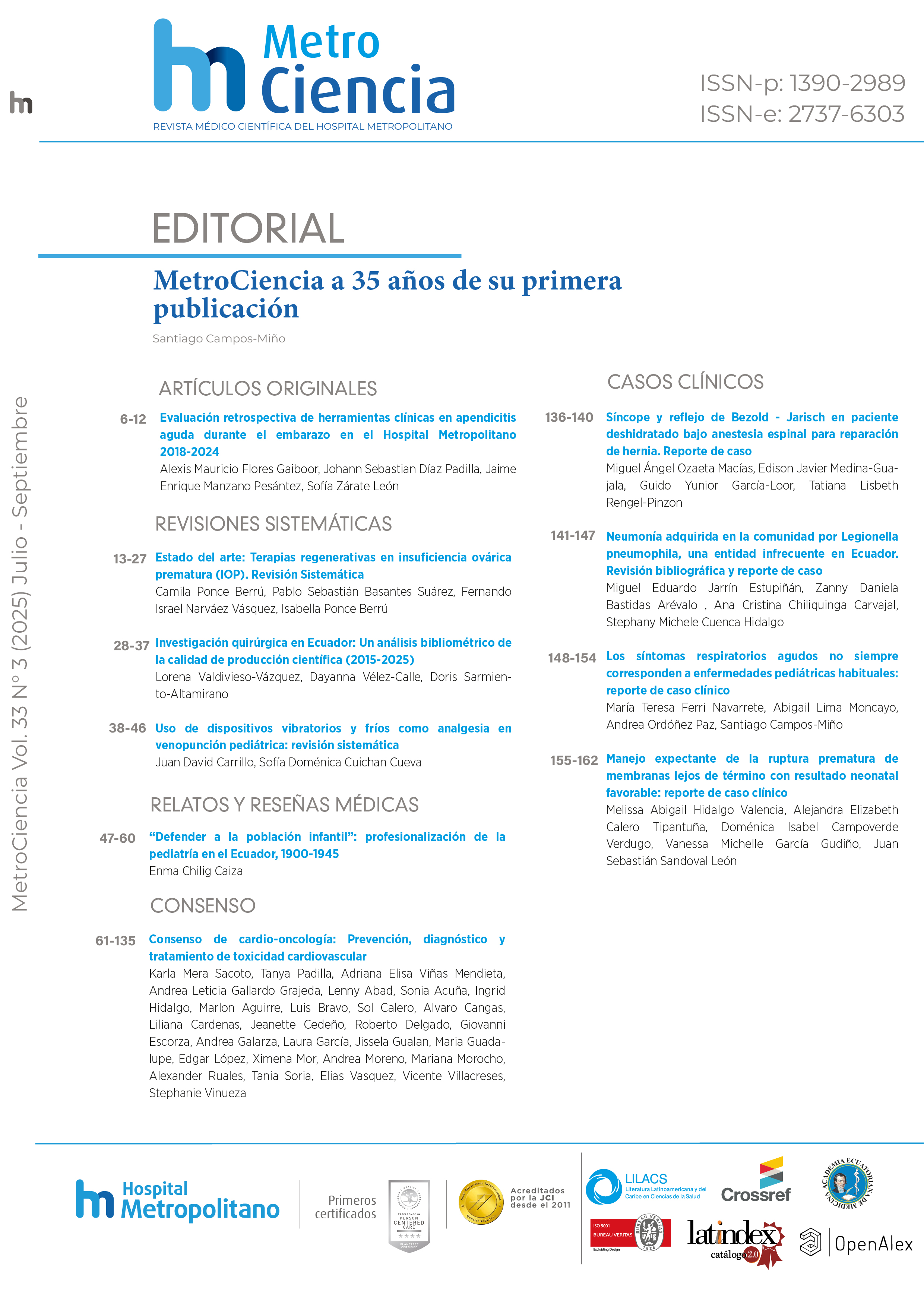
Cardio-oncology consensus: Prevention, diagnosis, and treatment of cardiovascular toxicity
DOI:
https://doi.org/10.47464/MetroCiencia/vol33/3/2025/61-135Keywords:
cardiology, cardiotoxicity, cardiac dysfunction, chemotherapy, ischemiaAbstract
Cardio-oncology is a subspecialty that is experiencing significant advances through research and a commitment to education, both for healthcare professionals (cardiologists, oncologists, hematologists, radiologists, etc.), and for patients and their awareness of potential risks and complications during anticancer treatment. In this document, we review strategies for cardiotoxicity risk stratification, primary and secondary prevention measures, and various aspects of diagnosis, management, and prognosis for cancer survivors, taking into account international recommendations and adapting them to our setting. Topics considered key have been considered, especially for the adequate identification of cardiotoxicity by the different groups of anticancer agents and radiotherapy. The primary source for this Executive Summary is the 2022 Cardio-Oncology Guidelines of the European Society of Cardiology, the Heart Failure Society, and the Cardio-Oncology Consensus. The Cardio-Oncology Consensus of the Ecuadorian Society of Cardiology offers a narrative review of important aspects in the prevention and treatment of cardiotoxicity.
Downloads
References
Mera Sacoto K.. Padilla Molina T,Abad L, Acuña S y cols. (2025). Consenso de cardio-oncología: prevención, diagnóstico y tratamiento de toxicidad cardiovascular sociedad ecuatoriana de cardiología. Metro Ciencia.
Organización Panamericana de la Salud.(2022). Disponible en https://www.paho.org/es/temas/cancer#:~:text=En%20el%202022%2C%20caus%C3%B3%201,6%2C7%20millones%20en%202045
Lyon, A. R., López-Fernández, T., Couch, L. S., et al. (2022). 2022 ESC Guidelines on cardio-oncology. European Heart Journal, 43(41), 4229-4361. https://doi.org/10.1093/eurheartj/ehac244
Lang, R., Badano, L., Mor-Avi, V., et al. (2015). Recommendations for Cardiac Chamber Quantification by Echocardiography in Adults. Journal of the American Society of Echocardiography, 28(1), 1-39.
Harries, I., Liang, K., Williams, M., Berlot, B., Biglino, G., Lancellotti, P., & et al. (2020). Magnetic resonance imaging to detect cardiovascular effects of cancer therapy. JACC: CardioOncology, 2(2), 270–292. https://doi.org/10.1016/j.jaccao.2020.05.001
Fanaroff, A. C., & Sun, L. L. (2023). High-sensitivity troponin in patients with cancer. JACC: CardioOncology, 5(5), 610-612. https://doi.org/10.1016/j.jaccao.2023.09.005
Fang, K., Zhang, Y., Liu, W., & He, C. (2021). Effects of angiotensin-converting enzyme inhibitor/angiotensin receptor blocker use on cancer therapy-related cardiac dysfunction: a meta-analysis of randomized controlled trials. Heart failure reviews, 26(1), 101–109. https://doi. org/10.1007/s10741-019-09906-x
Avila, M. S., Siqueira, S. R. R., Waldeck, L., Ayub-Ferreira, S. M., Takx, R., Bittencourt, M. S., & Bocchi, E. A. (2023). Renin- angiotensin System Antagonists and Beta-blockers in Prevention of Anthracycline Cardiotoxicity: a Systematic Review and Meta-analysis. Antagonistas do Sistema Renina- Angiotensina e Betabloqueadores na Prevenção da Cardiotoxicidade por Antraciclinas: Revisão Sistemática e Metanálise. Arqui- vos brasileiros de cardiologia, 120(5), e20220298. https://doi.org/10.36660/abc.20220298
Lucà, F.; Parrini, I.; Abrignani, M.G.; Rao, C.M.; Piccioni, L.; Di Fusco, S.A.; Ceravolo, R.; Bisceglia, I.; Riccio, C.; Gelsomino, S.; et al. Mana- gement of Acute Coronary Syndrome in Cancer Patients: It’s High Time We Dealt with It. J. Clin. Med.2022,11,1792
Van Nimwegen FA, Schaapveld M, Cutter DJ, Janus CPM, Krol ADG, Hauptmann M, Kooijman K, Roesink J, van der Maazen R, Darby SC, et al. Radiation dose-response relationship for risk of coronary heart disease in survivors of Hodgkin lymphoma. J Clin Oncol. 2016;34:235– 243
Herrmann J, Lenihan D, et al. Defining cardiovascular toxicities of cancer therapies: an International Cardio-Oncology Society (IC-OS) consensus statement. European Heart Journal 2022 igual a 12.
Porta-Sánchez A, Gilbert C, Spears D, Amir E, Chan J, Nanthakumar K,Thavendiranathan P. Incidence, Diagnosis, and Management of QT Prolongation Induced by Cancer Therapies: A Systematic Review. J AmHeart Assoc. 2017 Dec 07;6(12)
Al-Khatib SM, Stevenson WG, Ackerman MJ, Bryant WJ, Callans DJ, Curtis AB, et al. 2017 AHA/ACC/HRS guideline for management of patients with ventricular arrhythmias and the prevention of sudden cardiac death: Executive summary: a report of the American College of Cardiology/American Heart Association Task Force on Clinical Practice Guidelines and the Heart Rhythm Society. Heart Rhythm 2018;15:e190–e252.
Karlsson LO, Nilsson S, Bang M, Nilsson L, Charitakis E, Janzon M. A clinical decision support tool for improving adherence to guidelines on anticoagulant therapy in pa tients with atrial fibrillation at risk of stroke: a cluster-randomized trial in a Swedish primary care setting (the CDS-AF study). PLoS Med 2018;15:e1002528. https://doi. org/10.1371/journal.pmed.1002528152. Yun JP, Choi EK, Do Han K, Park SH, Jung JH, Park SH, et al. Risk of atrial fibrillation according to cancer type: a nationwide population based study. JACC CardioOncology 2021;3:221–232.
2024 ESC Guidelines for the management of atrial fibrillation developed in collaboration with the European Association for Cardio-Thoracic Surgery (EACTS), European Heart Journal (2024) 00, 1–101 https://doi.org/10.1093/eurheartj/ehae176
Zamorano JL, Lancellotti P, Rodriguez Munoz D, Aboyans V, Asteggiano R,Galderisi M et al. 2016 ESC Position Paper on cancer treatments and cardiovascular toxicity developed under the auspices of the ESC Committee for Practice Guidelines: the Task Force for cancer treatments and cardiovascular toxicity of the European Society of Cardiology (ESC). Eur Heart J 2016;37:2768–801.
Vahanian A, Beyersdorf F, Praz F, et al. 2021 ESC/EACTS Guidelines for the management of valvular heart disease. Eur Heart J. 2022; 43(7): 561–632.
Cehic DA, Sverdlov AL, Koczwara B, Emery J, Ngo DTM, Thornton-Benko E. The importance of primary care in cardio-oncology. Current Oncol treatment options. 2021;22(12):107
Ischetti, F.; Greco, G.; Cataldi, S.; Minoia, C.; Loseto, G.; Guarini, A. Efectos de la intervención de ejercicio físico sobre la aptitud física y psicológica en pacientes con linfoma. [en línea] PubMed, enero, 2020] en: https://www.ncbi.nlm.nih.gov/pubmed/31315290
Rebollo, J. Beneficios del deporte en los pacientes con cáncer [en línea] Blog Quirón Salud, julio, enero, 2020 en: https://www.quironsalud.es/blogs/es/cancer-ahora/beneficios-deporte-pacientes-cancer
Downloads
Published
Issue
Section
License
Copyright (c) 2025 Karla Mera Sacoto, Tanya Padilla, Adriana Elisa Viñas Mendieta, Andrea Leticia Gallardo Grajeda, Lenny Abad, Sonia Acuña, Ingrid Hidalgo, Marlon Aguirre, Luis Bravo, Sol Calero, Alvaro Cangas, Liliana Cardenas, Jeanette Cedeño, Roberto Delgado, Giovanni Escorza, Andrea Galarza, Laura García, Jissela Gualan, Maria Guadalupe, Edgar López, Ximena Mor, Andrea Moreno, Mariana Morocho, Alexander Ruales, Tania Soria, Elias Vasquez, Vicente Villacreses, Stephanie Vinueza

This work is licensed under a Creative Commons Attribution 4.0 International License.
How to Cite